
Introduction
Google has been pioneer in introducing innovations for decades. “We’ve been doing AI since before it was cool”, this is a statement Google I/O 2023 conference brought forward. This statement reflects two aspects, one Google’s longstanding commitment to artificial intelligence and second highlights their role as pioneers in the field. In this article, Google’s AI journey and their role as leaders in this transformative technology will be explored.
Google’s Early AI Ventures
Google recognized AI’s potential and began investing in the field Long before it became a catchword. Projects like Google Brain, was established in 2011, which was aimed to explore machine learning algorithms and their applications. This foundational research laid the groundwork for subsequent breakthroughs in AI-driven technologies and services.
DeepMind Acquisition
In 2014, Google made a landmark acquisition by bringing DeepMind, a leading AI research company, under its umbrella. DeepMind’s cutting-edge work in areas such as reinforcement learning and neural networks catapulted Google’s AI capabilities even further. The acquisition showcased Google’s determination to lead the AI revolution and set the stage for groundbreaking advancements.
Development of TensorFlow
Google introduced TensorFlow in 2015 to standardize AI. This became one of the most widely AI used tools and enabled the other developers to build their own intelligent applications.
AI Integration in Google’s Services
Google has seamlessly integrated AI into numerous products and services, enhancing user experiences and streamlining processes. From Google Assistant’s natural language processing capabilities to the image recognition prowess of Google Photos, the company has leveraged AI to empower its users and deliver intelligent solutions. Their continuous focus on AI-driven innovation has solidified Google’s position as a leader in the tech industry.
Beyond Cool: AI for Social Impact
Google’s commitment to AI extends beyond commercial applications. The company actively promotes the use of AI for social good. Initiatives such as the Google AI Impact Challenge and AI for Social Good program demonstrate their dedication to addressing global challenges through AI-powered solutions. By leveraging their expertise, Google strives to create a positive and meaningful impact on society.
Highlights
- Google highlighted past AI projects including AI-powered search, Google Photos’ magic eraser, Deepmind’s AlphaGo, Gmail’s Smart Reply and Smart Compose and Google Lens.
- Google did not discussed its primary AI product at I/O. The Assistant’s last major display product launch was in March 2021. Since then Google has shipped hardware without Assistant support. Assistant Driving Mode was closed in 2022 and Google Tasks Reminders taking place of ‘’reminders’’ one of the Assistant’s biggest features.
- The Pixel Tablet was launched without a dedicated smart display interface unlike Google Assistant devices.
- Google is trying to draw some kind of distinction between it and OpenAI, which got to the point it’s at by being a lot more aggressive in its rollout compared to Google. An example of this was OpenAI’s GPT-4 arrival, which came with the surprise announcement that it had been running as a beta on production Bing servers for weeks.
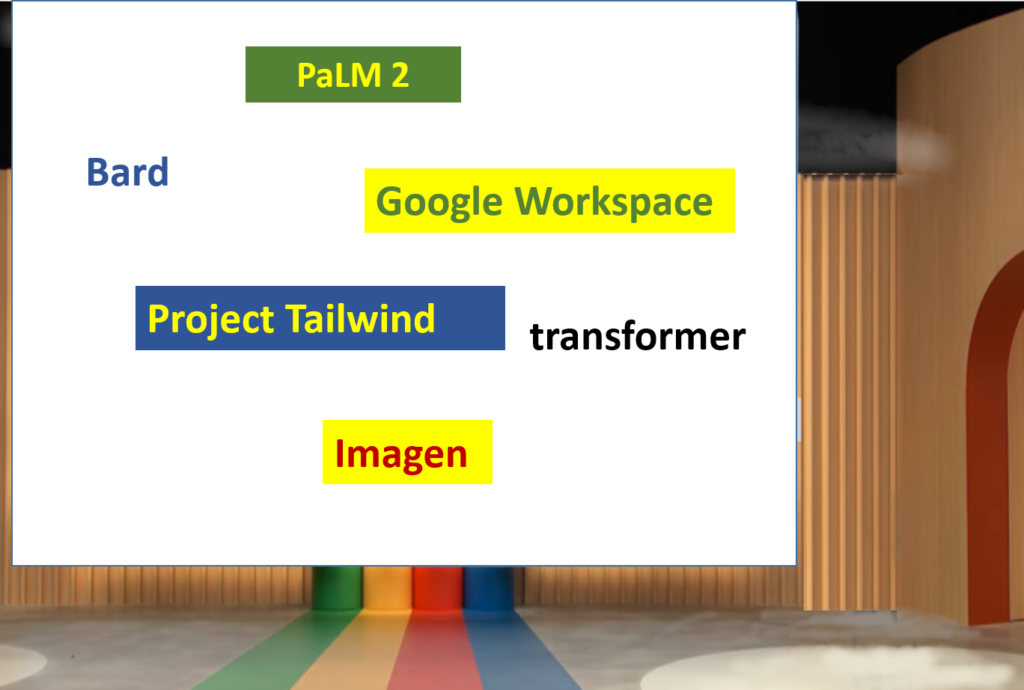
- PaLM 2
- At Google I/O held on 10 May 23, Google CEO Sunda Pichai announced approach of Language Model 2 (PaLM 2). It will be the fundamental AI model and AI large language model (LLM) to be used in Google AI products, including the Bard chatbot and will be serving with expanded reasoning, language and coding capabilities. Previously PaLM was trained on 540 billion language parameters released in April 2022. PaLM 2 is being launched to be a competitor to OpenAI’s GPT-4 and Microsoft’s Bing AI.
- Bard. Bard is Google’s experimental, conversational and AI chat service. It is developed to operate as ChatGPT, with the difference that Google’s service will fetch its information from the web. Bard is operated by Google’s advanced PaLM 2, a large language model (LLM). Initial version of Bard used a lightweight model version of LaMDA (Language Model for Dialogue Applications), which was built on Transformer, Google’s neural network architecture that it invented and open-sourced in 2017.
- Google Workspace. All Google Workspace plans provide a custom email for you and includes associated tools like Gmail, Drive, Calendar, Meet, Docs, Forms, Chat, Sheets, Slides and Sites etc.
- Project Tailwind. Google’s ‘Project Tailwind’ is an AI effectively a notebook that helps with study and in research information as required. It will enable users to ask the AI questions in natural language and get responses to assist in the context of their documents. It has the provision of buttons for “New Ideas,” “Summary’’ and “Reading Quiz,”. Effectively, this can create study guides based on the information you give it to help with study and learning.
- Google text to Image Diffusion Models. Google has unveiled text-to-image diffusion model ‘’Imagen’’. Imagen combines the language models with diffusion models.
Challenges
Google is in the midst of a total alarm over the rise of OpenAI and its flagship product, ChatGPT, which has excited Wall Street and has the potential to steal research queries, which people may ask from Google.
Development of ChatGPT is pursuance of Google’s technology. Google invented “transformer,” a neural network technique in 2017, however, not commercialized it. The transformer’s “T” has presentation in “ChatGPT” as T. OpenAI developed its product around Google’s public research.
Conclusion
“We’ve been doing AI since before it was cool,” is an evidence ofGoogle’s dedication to artificial intelligence. Acquisition of DeepMind, development of TensorFlow, and integration of AI into various products have proved Google’s prominent position in the field. With increasing AI use, Google remains at the forefront, driving innovation and setting new standards for the industry.